
From Stubble to Soil Wealth
From Stubble to Soil Wealth
The Case for a Flagship Biochar Park in Ladwa and a Farmer-First Biochar Mission for Haryana
Bhavya Bishnoi & Shivang Singh
Bhajan Global Impact Foundation | Green Gold Carbon
A farmer-first pathway for cleaner air, healthier soils, and a circular rural economy
Executive Summary
Haryana has made real and measurable progress against stubble burning. Officially recorded farm fires fell from 2,303 in 2023 to 1,406 in 2024 and 662 in 2025 – a decline of 71 per cent in two years and 91 per cent from 2021.[1] This achievement reflects sustained work by the State Government, district administrations and, above all, farmers. Machinery support, per-acre incentives, village-level mobilisation, monitoring, and new industrial uses for paddy straw have all contributed.
The progress made in reducing stubble burning creates the right moment for the next policy step. The remaining problem is not primarily a lack of awareness or willingness among farmers, but one of time, logistics, and economics. A farmer may have only 15-20 days between harvesting paddy and sowing wheat. Paddy straw is bulky, expensive to collect and transport, and often has no assured buyer close enough to the farm. Burning clears a field quickly and at almost no immediate cash cost. Unless the alternative is equally timely and economically credible, the pressure to burn will return each season.
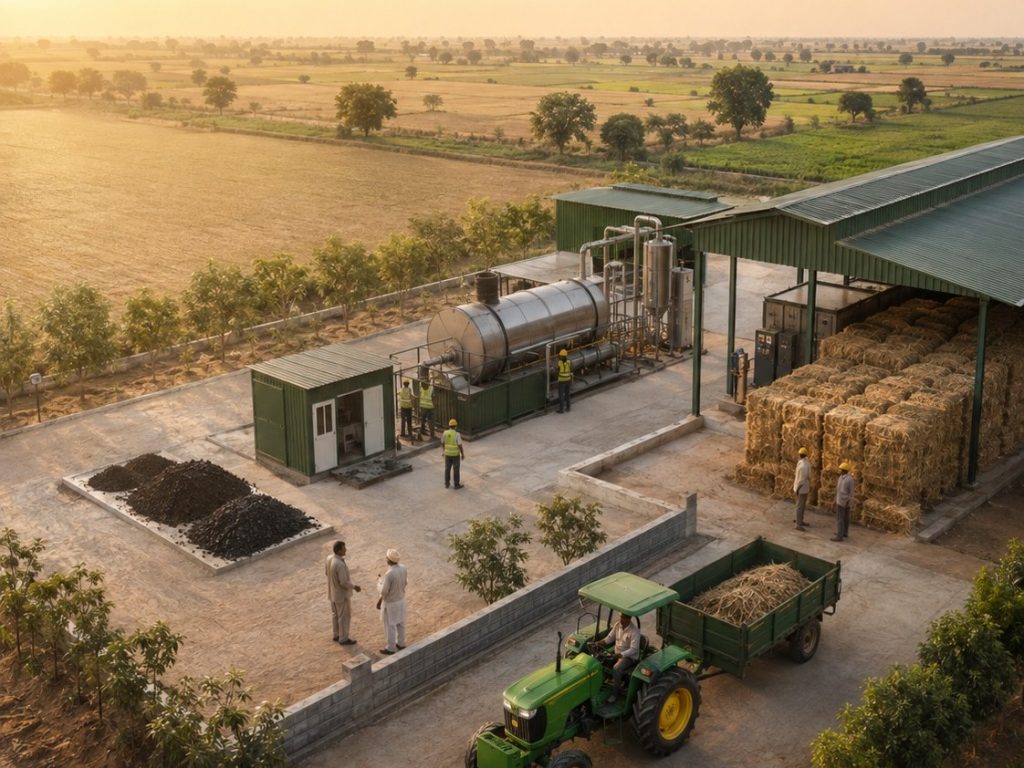
The proposal for a flagship Biochar Park in Ladwa, Kurukshetra, addresses this missing link. Biochar is a carbon-rich material made by heating crop residue in a controlled, low-oxygen process called pyrolysis. Properly produced biochar can convert paddy straw into a saleable soil amendment, stabilise part of the carbon in the biomass for a century or more, and create access to high-integrity carbon-removal markets. The process may also produce usable heat and other co-products, depending on the technology and market.
The case for the Park is, therefore, not that biochar should replace Haryana’s present crop-residue strategy. It should complete it. The Park can act as a permanent demand centre connecting farmers, Custom Hiring Centres, balers, FPOs, PACS, transporters, researchers, product buyers, and carbon-market institutions. Farmers can earn from supplying straw; rural enterprises can earn from collection and logistics; and participating farmers can receive scientifically prescribed biochar to improve soil function over time.
1. A Problem of Time, Logistics, and Economics
Stubble burning is often discussed as though it were simply a behavioural choice. That framing is incomplete and unfair to farmers.
The rice-wheat cycle creates an unusually compressed calendar. Measures that delay paddy transplantation help conserve groundwater, but they also push harvesting closer to the preferred wheat-sowing period. After a combine harvester passes, loose straw remains across the field. Much of the non-basmati residue has limited fodder value, while baling, loading, and transport require machinery, labour, and working capital. A farmer facing the next sowing deadline is, therefore, choosing among options with very different costs and speeds.
BGIF’s research dossier, drawing on government filings and standard technical estimates, places Haryana’s annual paddy-straw generation at roughly 7.7-8.0 million tonnes.[2] Most of this is already managed through in-situ incorporation, fodder, and a growing range of ex-situ uses. The important point is not that all residue is burned, but that even a smaller residual volume becomes a large logistical challenge when it must move within a few weeks.
This is why the solution cannot depend on moral persuasion alone. Farmers have repeatedly shown that they will adopt alternatives when those alternatives are timely, accessible, and affordable. Public policy must, therefore, reduce the cost and uncertainty of doing the right thing.
2. Why Stubble Burning Matters
Health and air quality
Open burning produces smoke containing fine particulate matter, black carbon, carbon monoxide, nitrogen oxides, and other harmful compounds. PM2.5 is especially dangerous because the particles can travel deep into the lungs and enter the bloodstream. The World Health Organisation links exposure to fine particulate pollution with respiratory disease, heart disease, stroke, and lung cancer.[3]
The first people exposed are often not distant city residents, but rural families living close to the fields. A peer-reviewed study using health data for more than 250,000 people found that residents of areas with intense crop burning were substantially more likely to seek treatment for acute respiratory infection, with young children especially vulnerable.[4] A separate national modelling study found that crop-residue burning imposes a significant PM2.5-related health burden across India and that Punjab, Haryana, and Uttar Pradesh account for most of the associated exposure.[5]
Stubble burning is not the only source of North India’s winter pollution. Vehicles, industry, road dust, construction, power, household fuels, waste burning, and weather conditions all matter. A credible case against stubble burning need not exaggerate its share. It suffices to recognise that it is a preventable source that arrives in a concentrated seasonal burst, and affects both rural and urban communities.
Soil, climate, and the farm itself
Burning rapidly removes the residue, but it also releases carbon and other pollutants that would otherwise remain in the biomass. Repeated fires can reduce surface organic matter and nutrient recycling, expose the soil, and damage organisms in the upper soil layer. ICAR literature has documented losses of plant nutrients and harm to soil micro-organisms from crop-residue burning.[6]
This matters because residue is not merely waste. It contains carbon and nutrients drawn from the same agricultural system to which it can, in a safer form, be returned. Treating residue as a resource creates the possibility of addressing air pollution and soil decline together.
Haryana’s wider soil-water position makes that connection urgent. Under the accepted Indian soil-health bands, organic carbon below 0.5 per cent is low, 0.5-0.75 per cent is medium, and above 0.75 per cent is high. Findings from Haryana’s Har Khet-Swasth Khet sampling exercise indicate that roughly 80 per cent of tested soils were low in organic carbon and barely 1.3 per cent exceeded 0.75 per cent.[7] The State also extracts 136.75 per cent of its annual extractable groundwater, while around 61.5 per cent of assessment units are over-exploited.[8] The case for action is, thus, about far more than stopping fires.
It is ultimately a food-security case. Haryana produced approximately 135.8 lakh tonnes of wheat and 71.4 lakh tonnes of rice in 2024-25, and remains one of India’s principal food-security anchors.[9] The task is to protect this national food engine by rebuilding the soil and water foundations beneath it.
3. Haryana’s Progress Deserves Recognition
Haryana’s results demonstrate that determined public action works.
| Paddy season | Recorded farm fires in Haryana | Change from previous year |
| 2023 | 2,303 | – |
| 2024 | 1,406 | -39% |
| 2025 | 662 | -53% |
Source: Commission for Air Quality Management / Press Information Bureau.[10]
The State has built a broad crop-residue management framework. It includes subsidised machinery, Custom Hiring Centres, financial support for in-situ and ex-situ management, crop diversification, village incentives, field monitoring, and enforcement. Haryana’s Agriculture Department currently describes machinery subsidies of 40-50 per cent for individual farmers and an operational incentive of ₹ 1,200 per acre for residue management.[11]
Ex-situ utilisation has also expanded through biomass energy, industrial boilers, ethanol, pellets and briquettes, brick kilns, packaging, and other applications. IndianOil’s 100-kilolitre-per-day 2G ethanol plant at Panipat, designed to use rice straw, is an important demonstration that agricultural residue can become an industrial feedstock.[12]
These are not small achievements. Any new proposal should build on them rather than imply that previous efforts have failed.
4. The Remaining Gap: An Assured Buyer Near the Farm
The existing system is strong at reducing the immediate pressure to burn. It is less complete at creating a dependable, year-round market for every tonne of surplus straw. Four structural gaps remain.
First, machinery does not by itself create demand. A baler can collect straw, but someone must buy it at a price that covers collection, storage, and transport.
Second, biomass is bulky and location-sensitive. The farther straw travels, the more transport erodes its value. Large central plants are useful, but each has a practical collection radius. Areas outside that radius may remain underserved.
Third, the harvest window compresses the entire supply chain. Machinery, labour, storage space, transport, and buyers must all be available at the same time. A breakdown in any one link can leave residue stranded.
Fourth, small farmers cannot individually access high-value environmental markets. Carbon removal requires measurement, traceability, verification, certification, and a credible buyer. These functions must be aggregated by an institution with scale and technical capacity.
The missing institution is, therefore, not simply another machine or subsidy. It is a reliable demand centre that can coordinate the entire chain from field to finished product.
5. Biochar as a Practical Part of the Solution
Biochar is produced when biomass is heated in a controlled environment with little oxygen. Unlike open burning, well-designed pyrolysis captures more of the biomass’s carbon in a stable solid form. Depending on the equipment, the process can also recover useful heat, gas or liquid co-products.
For Haryana, biochar offers five linked advantages.
5.1 It creates a new destination for difficult residue
Paddy straw that has limited fodder or local industrial demand can become feedstock for a standardised product. A facility with contracted capacity gives farmers, balers, and aggregators greater certainty before the harvest begins.
5.2 It can return stable carbon to the soil
Biochar’s porous structure can improve soil structure, nutrient retention, and water behaviour under suitable conditions. Its effects vary with feedstock, pyrolysis temperature, soil type, crop, and application rate. This is particularly important in Haryana, where many soils are alkaline: claims from acidic or tropical soils cannot simply be copied. Local trials through CCS Haryana Agricultural University, Krishi Vigyan Kendras, and accredited laboratories should determine the right formulation and dose.
The scientific evidence is promising, but should be stated carefully. A global meta-analysis found that biochar used with fertiliser increased crop yields on average compared with fertiliser alone, while biochar used alone did not consistently raise yield.[13] Reviews also show that water-retention benefits are often stronger in coarse-textured soils, and may be limited or different in other soils.[14] The correct policy promise is, therefore, not an automatic percentage increase in yield or reduction in fertiliser. It is a scientifically testable pathway to better soil function and more efficient input use.
5.3 It can generate durable carbon-removal value
Carbon in raw residue would normally return to the atmosphere relatively quickly through decay or burning. Pyrolysis converts part of it into a more persistent form. Leading high-integrity standards such as Isometric and Puro.earth provide methods for quantifying removals from converting waste biomass into biochar and placing it in approved soil or non-soil uses, with durability periods of a century or longer subject to biochar properties and monitored end use.[15][16]
Carbon revenue, however, is earned only after rigorous measurement, reporting. and verification. Feedstock must be eligible; project emissions must be counted; biochar quality and carbon stability must be tested; final use must be tracked; and double-counting must be prevented.
5.4 It supports a diversified rural industry
A biochar park can create demand for baling, loading, transport, storage, plant operations, maintenance, laboratory testing, digital traceability, and agricultural extension. Additional value may come from heat and other co-products, but these markets must be demonstrated rather than assumed.
The Park is, therefore, best understood as a biorefinery: one local feedstock separated into several economic pathways. Biochar returns stable carbon to soil; bio-vinegar (or pyroligneous acid) can support agricultural bio-stimulant and crop-protection formulations; tar oil can be harnessed for infrastructure, bio-bitumen and energy applications; renewable syngas can supply process heat; and silica-rich ash offers a future green-silica pathway for materials and chemicals. The result is a more resilient industrial proposition than a single-product straw-processing plant.
5.5 It complements, rather than displaces, other residue uses
No single technology should attempt to consume all paddy straw. Fodder, in-situ incorporation, ethanol, compressed biogas, paper, pellets, biomass energy, and biochar can coexist. District-level planning should direct each type of residue to the highest-value practical use. Biochar is especially useful where it fills an offtake gap and where returning stable carbon to soil creates an additional public benefit.
6. What the Farmer Should Gain
The mission will succeed only if the farmer’s benefit is clear, timely, and transparent.
The first benefit is a farm-gate or village-level payment for straw. The price must be announced before harvesting, and must reflect whether the farmer, baler or park bears collection and transport costs.
The second is freedom from a disposal cost and deadline risk. A reliable collection schedule reduces the risk of delayed wheat sowing.
The third is a fair share of carbon value. Farmers provide the feedstock and, where biochar is applied to their land, the storage location. A defined share of net verified carbon revenue should return to participating farmers through a transparent formula and direct payment.
The fourth is access to tested biochar-based soil inputs. Participating farmers should receive biochar or biochar-compost blends only with soil testing, crop-specific advice, and demonstrations. This protects farmers from exaggerated claims and allows the State to measure real changes in soil organic carbon, moisture, nutrient-use efficiency, input cost, and yield.
The fifth is local enterprise and employment. FPOs, PACS, panchayats, Custom Hiring Centres, and rural youth can operate collection points, balers, transport contracts and service businesses around the Park.
The central change is simple: the farmer moves from being asked to dispose of a liability to being paid as a supplier to a rural industry.
7. Lessons from India and the World
Biochar is no longer only a laboratory idea. Several models offer practical lessons for Haryana.
| Example | What has been done | Lesson for Haryana |
| Himachal Pradesh, India | A State-supported programme has brought together the Forest Department, Dr Y.S. Parmar University and a private developer. The model links public coordination, scientific research, private investment, community biomass collection, and carbon-credit development. The State has reported a biomass purchase price of ₹ 2.50 per kg and progress on plants at Neri and Jahu.[17] | Use a formal public-research-private partnership; pay communities for feedstock; and make independent research part of the project architecture. |
| Varaha-Google, India | Google announced an agreement to purchase 100,000 tonnes of biochar carbon removal from Indian company, Varaha, by 2030, demonstrating that long-term corporate offtake can help finance scale.[18] | Seek an anchor carbon buyer early, but contract against verified delivery rather than projected credits. |
| Stockholm Biochar Project, Sweden | Stockholm’s city-led model converts collected park and garden waste into biochar while using process heat in the district-heating system.[19] | Combine feedstock collection, useful energy, product use and public coordination so that the business model has more than one source of value. |
| J-Credit, Japan | Japan’s government-backed J-Credit system includes a methodology for adding biochar to agricultural soils, supported by research institutions and real credit transactions.[20] | Standardised measurement and an organised domestic buyer market can turn soil carbon into a credible farm-linked asset. |
There is also an emerging policy precedent within India. Madhya Pradesh’s Renewable Energy Policy 2025 explicitly includes biochar within its definition of biomass-derived biofuels and allows eligible developers to access carbon-credit benefits under applicable rules.[21] Haryana can go further by creating a dedicated mission that integrates agriculture, industry, soil science, and climate finance.
Building on Haryana’s existing policy architecture
The proposed Mission would not create any parallel structure, but rather unify existing policies and programmes under a common system of action. The signed World Bank-supported Haryana Clean Air Project for Sustainable Development already designates ARJUN – the Artificial Intelligence for Resilient Jobs, Urban Air Quality and Next Gen Skills Council – as the State’s nodal special-purpose vehicle under the Planning Department. Its US$30 million DLI 4 expressly incentivises the collection and productive reuse of crop residue through pathways – including biochar – with the Department of Agriculture and Farmers’ Welfare as the implementing agency.[22] The institutional framework, performance-linked financing and explicit biochar mandate therefore already exist; the Mission can give them an industrial project and statewide delivery vehicle.
The Mission can also serve as the integration layer connecting the National Clean Air Programme (NCAP) and Haryana Clean Air Project for Sustainable Development (HCAPSD) for clean air; Crop Residue Management (CRM) under Rashtriya Krishi Vikas Yojana (RKVY) for machinery and straw mobilisation; Har Khet-Swasth Khet and the Soil Health Card scheme for soil intelligence; the PM Programme for Restoration, Awareness, Nourishment and Amelioration of Mother Earth (PM-PRANAM) for reduced chemical-fertiliser dependence and integrated nutrient management; the National Mission on Natural Farming (NMNF) and National Mission for Sustainable Agriculture (NMSA) for regenerative practice; and Pradhan Mantri Krishi Sinchayee Yojana (PMKSY) – Per Drop More Crop together with Mera Pani Meri Virasat for agricultural water security.[23] Haryana is not reinventing the wheel; it is joining several active wheels into one mission.
8. Why Begin with a Flagship Park in Ladwa
The proposal submitted to the Chief Minister envisages Ladwa in Kurukshetra district as the first demonstration site. This is logical for three reasons.
First, Kurukshetra lies within Haryana’s important paddy-growing belt, giving the pilot access to relevant feedstock and farmer networks. Second, the State can coordinate the project closely and visibly, allowing administrative bottlenecks to be resolved early. Third, a flagship in the Chief Minister’s constituency can demonstrate that the project is not an abstract climate initiative but a practical farmer-welfare and rural-industry programme.
This paper proposes a 60-tonne-per-day first refinery and a longer-term mission to productively use 2 million tonnes of paddy straw a year across Haryana by 2035. It projects 500,000 tonnes of biochar, sufficient to support the regeneration of approximately 1 million acres of agricultural land annually, 750,000 carbon credits, more than ₹ 750 crore in annual carbon revenue, and a wider annual economic contribution above ₹ 2,500 crore at full scale.[24] That is precisely why a flagship Park is valuable. It can replace assumptions with Haryana-specific evidence.
At design capacity, the first 60 TPD module would process approximately 18,000 tonnes of paddy straw annually into 5,000 tonnes of biochar, 1,800 tonnes of bio-vinegar, 900 tonnes of tar oil, renewable process gas, and over 6,000 tonnes of CO2 permanently removed from the atmosphere.
9. A Credible Path from Pilot to Statewide Mission
The Ladwa project should proceed through clear phases.
Phase 1: Validate before construction
- Map paddy straw within an economical collection radius, without double-counting residue already committed to other users.
- Sign conditional supply arrangements with FPOs, PACS, Custom Hiring Centres, and baler operators.
- Secure credible offtake for biochar and other material products.
- Select a carbon standard and prepare a conservative project design, life-cycle assessment, and monitoring plan.
- Complete environmental approvals, plant-emissions design, fire safety, and storage planning.
- Establish baseline soil data and a multi-season field-trial protocol with an independent agricultural university or ICAR institution.
Phase 2: Demonstrate through two crop cycles
- Publish the straw price and payment timeline before harvest.
- Track tonnes contracted, collected, rejected, processed, and stored.
- Test every production batch for carbon content, stability, ash, moisture, pH, salinity, contaminants, and safe agricultural use.
- Measure stack emissions and account for transport and energy use.
- Apply biochar through controlled demonstrations with farmer consent and agronomic guidance.
- Report farmer payments, jobs, operating reliability, and net verified carbon removal.
Phase 3: Scale only after independent review
District replication should follow evidence, not a uniform template. Larger paddy clusters may support hub-and-spoke parks; lower-density areas may need smaller modular units or collection links to existing facilities. Each district plan should compare biochar with ethanol, compressed biogas, pellets, paper, fodder, and in-situ management before allocating residue.
At statewide scale, this network can be organised as a soil energy grid. Much like an electricity grid, biochar parks would be located wherever three conditions overlap: residual burn-prone straw identified through satellite data, acute soil-water stress verified by government data, and inadequate nearby industrial demand identified through geospatial mapping. Ladwa would be the first node. Each park would create a defined ‘Zero Fire Radius’ in which straw is collected locally, refined continually, and returned to the soil season after season.
10. Governance Principles for Public Trust
A mission of this scale must be transparent enough to earn the trust of farmers, taxpayers, and carbon buyers.
Farmer-first contracts: procurement price, quality deductions, collection responsibility, and payment deadlines should be published in simple language before the season.
Independent science: soil and crop claims should be verified by CCS HAU, ICAR or another independent institution, not only by the technology provider.
No carbon-credit overstatement: carbon revenue should be booked only after issuance or under a firm, risk-adjusted offtake agreement. Public finances should not depend on an optimistic spot price.
High environmental standards: pyrolysis must use proper emissions control. Biochar should meet recognised quality standards and be tested for contaminants. The project should solve an air-pollution problem, not move it from fields to an industrial stack.
Transparent benefit sharing: the formula for sharing net carbon revenue with farmers and local institutions should be disclosed, independently audited, and visible through a public dashboard.
Open performance measurement: the mission should report not just fire counts, but tonnes of residue collected and processed, farmer income generated, biochar safely applied, soil outcomes, plant emissions, and verified net carbon removal.
Conclusion: From Seasonal Control to Permanent Value
Haryana has already shown that stubble burning can be reduced. The fall to 662 recorded incidents in 2025 is a significant achievement and a foundation for greater ambition. The next phase should not abandon enforcement, machinery support, diversification or existing ex-situ uses. It should add the one element that can make progress more durable: an assured economic destination for surplus straw.
Biochar is well suited to that role because it connects four objectives that are usually pursued separately – cleaner air, healthier soil, rural income, and carbon removal. Its promise is substantial, but credibility will depend on disciplined execution: realistic logistics, local agronomy, controlled emissions, product quality, verified carbon accounting, and a transparent share of value for farmers.
The flagship Biochar Park at Ladwa should, therefore, be understood not merely as a factory. It can be the first institutional node of a statewide residue-to-value network. If the pilot proves its economics and environmental performance, Haryana can scale a model in which farmers are paid suppliers, rural youth become entrepreneurs, agricultural residue becomes a resource, and carbon value helps finance the renewal of the soil from which that residue came.
Haryana played a defining role in India’s first Green Revolution by aligning science, infrastructure, procurement and farmer incentives. A Biochar Soil Carbon Mission offers the State an opportunity to apply the same practical logic to the next generation of agricultural challenges.
The goal should not only be a Haryana with fewer fires. It should be a Haryana which becomes a case study for a farmer-first pathway for cleaner air, healthier soils, and a circular rural economy.
Sources and Notes
- Ministry of Environment, Forest and Climate Change / Press Information Bureau, ‘Paddy Harvesting Season 2025 concludes with significant Reduction in Farm Fire Incidents across Punjab and Haryana,’ 1 December 2025. https://www.pib.gov.in/PressReleasePage.aspx?PRID=2197201&lang=2®=3
- Bhajan Global Impact Foundation, Haryana Parali Stats Dossier (2023-24 data synthesis supplied with this paper), drawing on Government of Haryana filings, PIB, ICAR-IARI and related technical sources.
- World Health Organisation, ‘How air pollution is destroying our health,’ accessed August 2026. https://www.who.int/news-room/spotlight/how-air-pollution-is-destroying-our-health
- Department of Agriculture and Farmers Welfare, Government of Haryana, ‘Crop Residue Management’ scheme page, accessed August 2026. https://agriharyana.gov.in/MechCRMScheme
- S. Chakrabarti et al., ‘Risk of acute respiratory infection from crop burning in India: estimating disease burden and economic welfare from satellite and national health survey data for 250,000 persons,’ International Journal of Epidemiology 48, no. 4 (2019). https://doi.org/10.1093/ije/dyz022
- R. Lan et al., ‘Air quality impacts of crop residue burning in India and mitigation alternatives,’ Nature Communications 13 (2022). https://www.nature.com/articles/s41467-022-34093-z
- ICAR-Indian Agricultural Research Institute, research and institutional material on crop-residue burning, nutrient loss and soil micro-organisms; see also Management options to alleviate the menace of rice residue burning in north-west India, Indian Journal of Agricultural Sciences 88, no. 11 (2018). https://epubs.icar.org.in/index.php/IJAgS/article/view/84879
- Department of Agriculture and Farmers Welfare, Government of Haryana, Har Khet-Swasth Khet soil-sampling data and organic-carbon classification, cited in State programme reporting.
- Central Ground Water Board, State-wise stage of groundwater extraction and assessment-unit classification, latest annexure accessed August 2026. https://cgwb.gov.in/PQ/Stage_of_Groundwater_Extraction_more_than-Annexure.pdf
- Government of Haryana, Economic Survey 2025-26, agriculture production estimates. https://cdnbbsr.s3waas.gov.in/s32b0f658cbffd284984fb11d90254081f/uploads/2026/04/2026041756492302.pdf
- Ministry of Environment, Forest and Climate Change / Press Information Bureau, ‘Paddy Harvesting Season 2025 concludes with significant Reduction in Farm Fire Incidents across Punjab and Haryana,’ 1 December 2025. https://www.pib.gov.in/PressReleasePage.aspx?PRID=2197201&lang=2®=3
- Department of Agriculture and Farmers Welfare, Government of Haryana, ‘Crop Residue Management’ scheme page, accessed August 2026. https://agriharyana.gov.in/MechCRMScheme
- IndianOil, news release on the 100 KLPD 2G ethanol plant at Panipat using rice straw, 27 August 2021. https://iocl.com/NewsDetails/59281
- Isometric, Biochar Protocol, current version accessed August 2026. https://registry.isometric.com/protocol/biochar/1.3
- L. Ye et al., ‘Biochar effects on crop yields with and without fertilizer: A meta-analysis of field studies using separate controls,’ Soil Use and Management 36 (2020). https://doi.org/10.1111/sum.12546
- R.P. Premalatha et al., ‘A review on biochar’s effect on soil properties and crop growth,’ Frontiers in Energy Research 11 (2023). https://doi.org/10.3389/fenrg.2023.1092637
- Puro.earth, ‘Advancing the Science of Biochar Permanence,’ 3 July 2025. https://puro.earth/insights/post/biochar-permanence/
- Government of Himachal Pradesh, releases on the State-supported biochar programme and progress of the Neri project, 27 August 2025 and 30 June 2026. https://himachalpr.gov.in/OnePressRelease.aspx?ID=42216&Language=1 and https://himachalpr.gov.in/OneNews.aspx?ID=47811&Language=1
- Google, ‘We’re announcing our first partnerships to scale biochar for CO2 removal,’ 16 January 2025; the Varaha project is located in India. https://blog.google/feed/were-announcing-our-first-partnerships-to-scale-biochar-for-co2-removal/
- C40 Cities, ‘Stockholm – World’s First Urban Carbon Sink with Biochar.’ https://www.c40.org/case-studies/cities100-stockholm-world-s-first-urban-carbon-sink-with-biochar/
- Government of Japan, J-Credit Scheme, methodology for biochar addition to mineral soil; Ritsumeikan University, Japan Biochar Research Center case material. https://japancredit.go.jp/english/methodologies/ and https://en.ritsumei.ac.jp/news/detail/?id=1062
- Government of Madhya Pradesh, Madhya Pradesh Renewable Energy Policy 2025 (official gazette supplied with this paper), including biochar within biomass-derived biofuels and provisions relating to carbon credits.
- Haryana Biochar Soil Carbon Mission: Concept Note for Government of Haryana and covering letter submitted to the Hon’ble Chief Minister, Haryana, 19 August 2026. Figures are proposal estimates requiring independent validation.
- World Bank, Haryana Clean Air Project for Sustainable Development, Programme Appraisal Document and Disbursement-Linked Indicator framework, 2025. https://documents1.worldbank.org/curated/en/099111925181018829/pdf/BOSIB-f7d2f1d1-dc81-4ec0-95fe-55552e1d375c.pdf
- Government of India, official programme material on PM-PRANAM and PMKSY-Per Drop More Crop. https://www.pib.gov.in/PressReleasePage.aspx?PRID=2239623&lang=1®=3 and https://pmksy.gov.in/microirrigation/Aboutus.aspx
This paper has been prepared by the Bhajan Global Impact Foundation as a policy case for consideration. It is intended to support technical appraisal and public discussion; it is not a substitute for a detailed feasibility study, environmental assessment, agronomic trial or investment memorandum.
Bhavya Bishnoi is Founder & Vice Chairman, Bhajan Global Impact Foundation, a non-profit driving transformative change through policy advocacy and high impact projects. Having studied at Harvard University, Oxford University, and LSE, Bhavya is an aspiring public servant, seeking to effect change at scale through development-based and compassion-driven politics. He is a former MLA from Adampur (Haryana), and currently serves as Vice President of the BJP in Haryana.
Shivang Singh is a serial climate entrepreneur. Formerly the Founder & CEO of Impacto, a full-stack climate solutions platform, he is now building Green Gold, a carbon removal infrastructure company working to solve northern India’s annual stubble burning crisis. A President’s Scholar from The University of Hong Kong and Hult Prize 2021 Global Finalist, he has worked extensively with enterprises and governments on diverse environmental projects.