
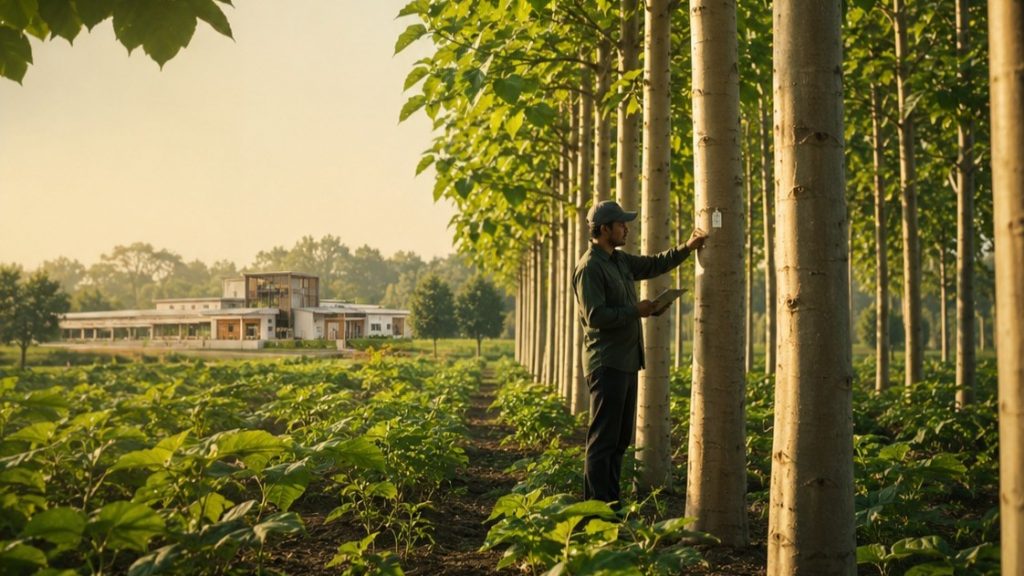
From Forest Scarcity to Green Prosperity
A Two-Part Strategy for Reforestation, Farmer-Led Agroforestry, and a Flagship Kiri Phoenix One® Programme in Haryana
Bhavya Bishnoi
Bhajan Global Impact Foundation
Restore nature where forests belong. Grow prosperity where trees work alongside farms.
Executive Summary
Haryana has transformed India’s food security, industry, and urban economy. Yet, the same small and intensively used land base that has powered this progress now faces an urgent ecological deficit. The India State of Forest Report 2023 records only 1,614.26 square kilometres of forest cover in Haryana—3.65 per cent of the State’s geographical area, and the lowest proportion among Indian states. Even after adding trees outside forests, total forest and tree cover is only 7.48 per cent.[1] This is far below the national policy aspiration of one-third green cover.
Low forest cover is not a cosmetic problem. Rather, it weakens Haryana’s natural protection against extreme heat, dust, soil erosion, rapid runoff, biodiversity loss, and climate volatility. It places greater pressure on the Aravallis and Shivaliks, leaves farms and settlements with fewer ecological buffers, and reduces the resilience of a landscape already managing groundwater stress and intensive cultivation. Haryana cannot postpone this issue; every year of fragmented action makes future restoration more difficult and expensive.
The central proposition of this paper is simple: Haryana needs one Green Prosperity Mission with two complementary engines.
- Reforestation must restore natural ecosystems where forests belong—especially degraded forest land, the Aravallis, Shivaliks, catchments, wildlife corridors, and eligible public or community land. This is primarily an ecological responsibility, led by government, and financed through CAMPA and other conservation resources.
- Agroforestry must build a productive tree economy across farms and other working landscapes. This is primarily a farmer-and-market partnership, supported by agricultural schemes, credit, FPOs, industry, and predictable regulation.
The distinction matters. A timber plantation cannot replace a native forest, and a native forest cannot be expected to meet every commercial need for wood. Reforestation protects Haryana’s ecological foundations; agroforestry gives farmers a profitable reason to expand tree cover outside forests. Together, they can increase green cover without displacing productive agriculture.
Within the agroforestry track, this paper proposes Kiri Phoenix One® as the flagship commercial hardwood for a Haryana pilot-to-scale programme, anchored in the Yamunanagar timber cluster and supported by district-specific portfolios of poplar, eucalyptus, melia, shisham, fruit, fodder, and native trees. Phoenix One® is a protected hybrid of Paulownia elongata and P. fortunei, developed through a long-running German breeding programme and selected for rapid, straight growth, a narrow crown, coppicing, non-invasive propagation, and high-value, lightweight timber. Its characteristics are well aligned with Haryana’s warm plains, intercropping tradition, entrepreneurial farmers, and established wood-processing base.
The national opportunity is equally important. Sector estimates place India’s annual foreign-exchange outflow on timber and the wider wood-products value chain at around ₹80,000 crore; narrower official trade categories for logs, lumber, and wood products report lower totals, reflecting differences in scope. Either way, the strategic direction is clear: India imports too much of the wood consumed by its growing housing, furniture, construction, and manufacturing sectors. A competitive domestic plantation-timber economy can retain value in India, reduce pressure on natural forests abroad, and create rural assets at home.
This is a win-win proposition. Farmers gain a medium-term timber asset, diversified income, and better-managed soils. Rural Haryana gains nurseries, farm services, harvesting, logistics, grading, and wood-processing jobs. The environment gains trees, carbon storage, reduced erosion, better air quality, and more resilient landscapes. Government gains progress on green cover, climate, and rural-development goals, better use of conservation funds, and a credible pathway towards timber import substitution.
Haryana’s first Green Revolution succeeded because public purpose, science, markets, and farmer incentives moved together. A Haryana Green Prosperity Mission can apply the same governing intelligence to the next great challenge: restore nature where forests belong and create prosperity where trees can work alongside farms.
1. The Scale of Haryana’s Green-Cover Deficit
Haryana’s low forest cover is partly explained by geography and history. The State is dominated by fertile plains, dense settlements, major roads, logistics corridors, and industry. Its farmers have used the land to make an exceptional contribution to India’s food security. The answer is, therefore, not to criticise agriculture or impose a false choice between farms and forests, but to recognise that an intensely productive State needs a more intelligent green infrastructure.
| Official Measure, ISFR 2023 | Total Area | % Share of Total Land | National Average |
| Forest cover | 1,614.26 sq. km | 3.65% | 21.76% |
| Tree cover outside forests | 1,693.02 sq. km | 3.83% | 3.41% |
| Total forest and tree cover | 3,307.28 sq. km | 7.48% | 25.17% |
Source: Ministry of Environment, Forest and Climate Change, based on India State of Forest Report 2023.[1]
The numbers reveal both the problem and the opportunity. Trees outside forests already account for slightly more cover than recorded forests. Haryana will, therefore, not close its green-cover gap through conventional forestry alone. It must protect and restore its limited natural ecosystems, while multiplying useful trees across farms, village commons, institutions, canals, roads, and urban landscapes.
Why immediate attention is warranted
- Heat and public health: Tree cover provides shade and evapotranspirative cooling. In villages, towns, and peri-urban belts, connected green areas can reduce heat exposure and intercept dust. As summers become hotter, green infrastructure is an essential public-health investment, not decoration.
- Water and watershed security: Vegetation slows runoff, protects slopes and stream banks, and improves infiltration where soils and geology permit. Native restoration in the Aravallis and Shivaliks is particularly important for catchments. At the same time, plantation design must respect Haryana’s groundwater stress; the goal is more ecological and livelihood value per unit of water.
- Soil health: Wind, bare soil, and intensive cultivation can reduce soil organic matter and biological activity. Tree roots, leaf litter, and shelterbelts can support aggregation, nutrient cycling, and erosion control. A landscape with too few trees is less able to absorb climatic shocks.
- Biodiversity and ecological continuity: Fragmented habitats isolate wildlife and reduce space for pollinators and birds. Native corridors, riparian buffers, hedges and mixed field trees reconnect parts of the landscape that commercial plantations alone cannot.
- Economic resilience: A State dependent almost entirely on annual crops loses the opportunity to create long-duration biological assets, rural wood industries, and domestic timber supply. Green scarcity is, therefore, an economic constraint as well as an environmental one.
The urgency is heightened by urbanisation and infrastructure growth. Once land, catchments, and corridors are fragmented, restoration becomes costlier. Haryana should treat green cover as it treats roads, irrigation, and power: as foundational infrastructure that must be planned, financed, measured, and maintained over decades.
This leads to the paper’s central strategic choice. Haryana should not collapse every tree-planting activity into one scheme, and instead pursue two linked but distinct tracks – reforestation for ecological repair and agroforestry for productive green growth.
2. Part One – Reforestation Rebuilding Haryana’s Ecological Estate
Reforestation means restoring the structure and function of natural ecosystems, not merely counting saplings. In Haryana, it should focus on landscapes where ecological outcomes are the first purpose: degraded forest land, the Aravalli and Shivalik systems, catchments, wildlife corridors, river and wetland buffers, and legally eligible public or community land.
What a serious reforestation programme should do
- Restore native ecosystems: Use assisted natural regeneration wherever rootstock and seed sources remain; supplement with locally appropriate native species rather than uniform plantations.
- Repair catchments before planting: Contour work, check structures, erosion control, fire lines, grazing management, and water planning often determine survival more than the planting event itself.
- Protect ecological corridors: Map and reconnect fragmented stretches in the Aravallis and Shivaliks, and create native buffers around water bodies and settlements.
- Fund maintenance and survival: Every project should provide for protection, watering where justified, replacement, community stewardship, and independent survival audits for at least three to five years.
- Measure outcomes, not expenditure: Public dashboards should report survival, canopy development, soil and water indicators, habitat improvement, and cost per surviving tree.
CAMPA: available capital that must become ecological assets
The Union Government transferred ₹1,282.65 crore to Haryana’s State CAMPA in 2019–20.[3] A Central Empowered Committee review covering 2019–20 to 2023–24, as publicly reported, placed Haryana’s utilisation at 57.4 per cent.[4] The implication is not that money should be spent hurriedly, but that Haryana needs a deeper pipeline of legally eligible, site-ready, and scientifically designed projects.
CAMPA is a statutory conservation mechanism arising from the diversion of forest land. Its proper role is to rebuild the State’s ecological estate through afforestation, assisted natural regeneration, forest protection, wildlife and biodiversity work, nurseries, fire management, and soil and water conservation (ibid.).
Haryana should create a rolling five-year Restoration Investment Shelf. Each project should settle land status, baseline ecology, species mix, water, protection, maintenance, community participation, and monitoring before approval. This would convert unspent balances into credible ecological work, while improving the State’s ability to absorb future allocations.
International experience supports this approach. For instance, Costa Rica reversed severe forest loss by combining protected areas, transparent forest governance, and payments for ecosystem services funded through durable public mechanisms.[5] Its lesson for Haryana is not to copy one instrument, but to make ecological restoration a long-term institution rather than an annual plantation campaign.
3. Part Two – Agroforestry: A Tree Economy Led by Farmers
Agroforestry is the planned integration of trees with crops, livestock or both. It includes boundary planting, wide-spaced timber-and-crop intercropping systems, fodder banks, windbreaks, silvopasture, and mixed systems on saline, degraded or underused land. Its strength is that one acre can produce annual farm income, medium-term tree value, and environmental services at the same time.
Haryana is well placed to lead. The poplar–wheat and poplar–sugarcane economy around Yamunanagar proves that farmers grow trees at scale when four conditions come together: reliable planting material, practical agronomy, predictable felling and transit rules, and credible buyers.[6] Agroforestry should, therefore, be designed as a robust economic system – from nursery to market – not merely a sapling-distribution scheme.
A four-way dividend
| Beneficiary | Economic Benefit | Environmental or Public Benefit |
| Farmers | A medium-term timber asset; income diversification; productive use of land; crops, fruit, fodder or fuel from mixed systems; possible organised offtake | Improved soil cover and nutrient cycling; shelter from wind and heat; greater resilience when annual crops face shocks |
| Rural economy | Nurseries, pruning, extension, harvesting, transport, grading, sawmilling, seasoning, panels, furniture, and engineered-wood jobs | New green skills and local value addition instead of exporting raw material or importing finished wood |
| Environment | Reduced pressure on natural forests and imported timber; durable wood can substitute more carbon-intensive materials | More tree cover, carbon storage, erosion control, habitat links, and improved microclimates when species and spacing are appropriate |
| Government and nation | Higher rural incomes, new enterprises, tax-generating value chains, and lower foreign-exchange outflow on wood imports | Progress on green cover, climate adaptation, land restoration and air-, soil- and water-quality goals |
For farmers, the central attraction is income diversification. Annual crops continue to support regular cash flow, while trees create a medium-term asset that can bolster existing revenue streams. Deep roots and leaf litter can improve soil structure, organic matter, and nutrient cycling; shelterbelts can reduce wind erosion. Improved soil health brought about by intercropping is likely to further enhance crop yields in the times to come.[7]
Government must help farmers manage risk, however. These include delayed tree income, uncertain timber prices, poor-quality clones, mortality, opaque grading, and regulatory friction. A credible mission should offer survival-linked incentives, credit with a moratorium aligned to rotation, mortality insurance, digital registration, simple harvest and transit rules, farmer aggregation through FPOs, and buyer-linked contracts with transparent grade and price formulas.
Farm agroforestry should be financed primarily through the Agroforestry Component of RKVY, CAMPA, funds, State resources, institutional credit, NABARD, industry partnerships, and verified environmental finance.[8] Agroforestry is, therefore, not a substitute for existing agricultural policy. It complements crop diversification, soil-health, water-efficiency, rural-enterprise, and climate-resilience programmes by adding a longer-duration asset to the farm economy.
4. Kiri Phoenix One® as Haryana’s Flagship Programme
Kiri is the commercial name used for Paulownia trees and hybrids. The specific proposition advanced here is Phoenix One®, a protected hybrid of Paulownia elongata and P. fortunei developed through long-running research and breeding programmes in Germany. The programme has progressed from research to commercial plantations in Germany and Spain, with more than 300,000 Kiri trees under management and planting material supplied internationally.[9]
Phoenix One® recently entered Indian market-development efforts, including a pilot in Banaskantha, Gujarat, Hubbali and Udipi, Karnataka, Sri Ganganagar, Rajasthan, and Miranpur, Uttar Pradesh.[10] Unlike generic Paulownia material, this proposition is based on a named, protected hybrid backed by years of breeding, trials, and cultivation, with the Indian programme selecting it for warm mainland conditions. Among new commercial hardwood candidates, Phoenix One® is the most suitable anchor species for Haryana. The State should move decisively to become the country’s leading research, cultivation, and processing centre for this timber (and others) – using certified material, Indian agronomic protocols, and Haryana-based performance data as the foundation for scale.
Why the fit is unusually strong
- An additional income stream for farmers and project owners: Verified carbon credits could provide farmers and plantation owners with a performance-linked source of income over and above earnings from timber and compatible intercrops. This would strengthen the financial proposition during the growing cycle and reward farmers for providing an environmental service to society.
- Exceptional carbon-sequestration potential and high environmental performance: Phoenix One® combines rapid growth with substantial biomass accumulation, giving it exceptionally high potential to capture and store atmospheric carbon. A well-managed plantation has the potential to sequester up to approximately 40 metric tonnes of CO₂ per hectare annually. Leaf litter and root systems can support soil function, while a narrow crown and disciplined spacing can retain intercrops during part of the rotation. Phoenix One® is also highly resistant to termites and fire.
- A crop designed for productive timber: Phoenix One® has been selected for rapid, straight growth, a compact crown, and valuable lightweight wood. Its narrow form can improve light management in appropriately spaced intercrops, while its coppicing ability allows regrowth after harvest and can reduce replanting costs in subsequent cycles
- Compatibility with Haryana’s enterprise culture: Farmers in the north-eastern districts already understand plantation timber and intercropping. The State has nurseries, traders, transporters, and skilled labour that can adapt more quickly than a greenfield region.
- A natural industrial anchor: Yamunanagar is one of India’s major plywood and wood-processing clusters. It offers laboratories, buyers, mills, and product-development capacity for furniture, veneer, boards, mouldings, interiors, and engineered products.
- Import substitution: India has a structural and growing demand for wood. Sector estimates put the wider timber and wood-products import dependence at roughly ₹80,000 crore annually, while official data for narrower classifications of logs, lumber, and wood products report about US$2.3 billion in 2023.[11][12] Domestic plantation timber cannot replace every imported species, but Kiri can serve selected lightweight hardwood and panel applications, retaining value and jobs in India.
- Access to a growing global carbon market: Carbon pricing and carbon-credit mechanisms are expanding worldwide as governments and businesses seek credible pathways to meet their climate commitments. A properly designed Phoenix One® programme could position Haryana to participate in this emerging green economy by generating high-integrity, nature-based carbon credits.
- Alignment with sustainable-development and climate priorities: The proposed programme would advance several United Nations Sustainable Development Goals (SDGs), particularly SDG 8 on decent work and economic growth, SDG 9 on sustainable industry and innovation, SDG 12 on responsible production, SDG 13 on climate action, and SDG 15 on life on land. It would also support Haryana’s medium- and long-term objectives concerning decarbonisation, climate resilience, sustainable land use, and green economic development.
Haryana should designate Phoenix One® as the flagship commercial species for the initial mission, backed by certified tissue-cultured stock, multi-location demonstration plots, zone-specific water budgets, standard intercropping protocols, buyer-approved wood testing, and transparent farmer contracts. Even though this paper recommends Phoenix One® as the most lucrative light hardwood species for Haryana from an economic and environmental standpoint, it should not become a monoculture. Poplar, melia, eucalyptus, shisham, bamboo, fruit and fodder trees, and native silvopasture species should form district portfolios based on soil, water, climate, market, and farmer preference.
5. From Demonstration to a Haryana Timber Economy
The flagship proposition is a Kiri Phoenix One® Bio-Economy and Timber Park in the Yamunanagar region, supported by satellite farmer clusters across suitable districts. The Park should be more than a plantation, by bringing together certified nurseries, field research, farmer training, a wood-testing laboratory, seasoning and grading, product design, primary processing, buyer development, and a transparent market platform.
The anchor-and-cluster model
An initial anchor estate of up to 1,500 acres – assembled through suitable public land, voluntary leased land, farmer aggregation or a combination – can demonstrate professional cultivation at meaningful scale. Around it, participating farmers should adopt boundary rows or appropriately spaced blocks under voluntary, well-explained contracts. The anchor supplies data and consistent raw material; the clusters spread ownership and income.
The programme should establish known use before mass planting. Yamunanagar’s manufacturers and national furniture, panel, packaging, and engineered-wood companies should test Phoenix One® for specific products, define moisture and grade standards, publish procurement specifications, and offer offtake formulas. This converts a promising tree into a bankable value chain.
Farmer protection should be built into the model, through:
- certified and traceable Phoenix One® planting material, with replacement protocols;
- a written agronomy and water plan matched to the plot;
- recommended intercrops and pruning schedules for the early rotation;
- credit repayment aligned with harvest and insurance against defined mortality risks;
- digital tree registration, measurement, and harvest records;
- independent grading and weighment; and
- a floor-price or reference-price formula linked to grade and market conditions.
One flagship, several district portfolios
| Haryana landscape | Priority Agroforestry Direction |
| Yamunanagar–Ambala–Kurukshetra–Karnal belt | Phoenix One® flagship clusters; poplar; melia; diversified timber-and-crop systems linked to processing |
| Central irrigated districts | Boundary timber, fruit-and-crop systems, and shelterbelts, selected through groundwater and crop-compatibility screens |
| South Haryana and Aravalli interface | Drought-tolerant native trees, fruit, fodder, and silvopasture; ecological buffers around restored native landscapes |
| Western, saline, and water-stressed zones | Salt- and drought-tolerant species, low-density shelterbelts, and pasture systems; avoid water-intensive plantation models |
| Peri-urban and institutional land | Native shade, urban forests where ecologically appropriate, fruit and timber demonstrations, and green corridors |
This portfolio approach protects farmers and the State from betting on one species or one market. Phoenix One® can remain the flagship commercial proposition because it offers a distinctive new hardwood opportunity; established and native species provide diversification, ecological fit, and different rotation lengths.
The industrial opportunity extends well beyond standing timber. Haryana can build expertise in tissue culture, nursery accreditation, farm advisory, remote monitoring, mechanised harvesting, kiln drying, grading, furniture components, panels, and low-carbon construction products. Each stage keeps more value in the rural economy and strengthens the case for replacing imported material with Indian-grown wood.
6. What Haryana Can Learn from India and the World
No successful forestry transition rests on planting alone. The strongest examples align tenure, long-term incentives, science, and markets.
| Example | What worked | Lesson for Haryana |
| Yamunanagar, Haryana | Poplar cultivation grew alongside plywood mills, traders, technical knowledge, and familiar intercrops. | Build the buyer and processing ecosystem at the same time as the plantation resource. |
| Karnataka Agroforestry and Silviculture Policy | Incentives are linked to planting and survival, with institutional support for farm forestry.[14] | Pay for surviving, well-maintained trees rather than seedlings distributed. |
| China’s Paulownia intercropping | Household forestry combined timber trees with food crops and local processing across suitable regions.[15] | Standardise spacing and intercrops; connect smallholders to nurseries, extension, and industry. |
| Costa Rica’s forest recovery | Protected areas and payments for ecosystem services created durable incentives for restoration. | Reforestation requires long-term institutions and stewardship, not one-season drives. |
| Brazil’s crop–livestock–forest systems | Research and extension helped producers combine trees, crops, and livestock in zone-specific models.[16] | Establish demonstration farms and recommend systems by agro-climatic zone, not by one statewide template. |
These examples point to five design rules for Haryana.
- Separate ecological and commercial objectives, then coordinate them. Native restoration should be judged by ecosystem recovery; agroforestry by farmer income, survival, water productivity, and market performance.
- Create markets before promising returns. Product standards, industrial trials, transparent grading, and credible buyers must precede large-scale farmer mobilisation.
- Pay for performance. Incentives should be released against verified survival and maintenance milestones. Carbon or ecosystem-service finance should reward independently measured outcomes.
- Design by place. Haryana’s irrigated north-east, central plains, Aravalli interface, and dry western districts require different trees and densities. A district tree portfolio is stronger than a statewide species mandate.
- Give farmers choice and protection. Participation must be voluntary, contracts understandable, planting material traceable, and dispute resolution accessible. Farmer confidence is the mission’s most valuable infrastructure.
Haryana can improve on these precedents by combining them in one coherent public platform: a restoration pipeline funded for long-term ecological outcomes; an agroforestry mission linked to agricultural policy; a flagship Phoenix One® centre linked to Yamunanagar industry; and a common digital system for nurseries, survival, tree registration, water use, carbon, and timber markets.
The goal is not simply more trees. It is a landscape in which the right tree grows in the right place, for the right purpose, with a responsible path from planting to value.
7. The Way Forward: Restore Nature, Grow Prosperity
Haryana has the farmers, institutions, markets, and wood-processing base to turn forest scarcity into national leadership. What has been missing is one proposition that joins ecological responsibility with economic ambition. The Haryana Green Prosperity Mission supplies it:
- Reforestation repairs native ecosystems, catchments, and corridors through CAMPA and conservation finance.
- Agroforestry creates farmer-owned tree assets and rural industry through agricultural policy, credit, FPOs, and markets.
- Kiri Phoenix One® becomes the flagship new hardwood, anchored in Yamunanagar, and developed through certified stock, Indian agronomy, farmer clusters, and product-led demand.
- District tree portfolios deploy other hardwoods, fruit, fodder, bamboo, and native species wherever local soil, water, and markets make them the better choice.
This agenda complements existing policy. It strengthens CAMPA delivery, adds a long-duration asset to crop diversification and soil-health programmes, supports water-sensitive land use, advances climate commitments, and builds a domestic timber industry capable of reducing the foreign-exchange outflow on imported wood.
Phoenix One® combines a long breeding history, a strong commercial timber profile, and characteristics aligned with Haryana’s warm plains and intercropping culture. Haryana should lead with confidence: protect farmers contractually, prove performance transparently, develop demand early, and scale quickly once published standards are met.
The vision is larger than any one species. Haryana’s farmers can leave its children greater wealth, cooler settlements, healthier soils, and restored hills; give farmers a productive asset alongside crops; enable entrepreneurs to manufacture from reliable domestic timber; and measure success by ecological and economic value that survives. The State can become a national model by restoring forests where nature needs them, growing timber where farmers benefit, and retaining more of India’s wood economy at home.
Sources and Notes
- MoEFCC, India State of Forest Report 2023: Haryana forest cover 1,614.26 sq. km; tree cover 1,693.02 sq. km; combined cover 7.48%.
- Haryana Forest Department, Haryana State Forest Policy, 2006 and official agroforestry programme pages.
- MoEFCC/PIB, State-wise Compensatory Afforestation Fund transfer, 2019–20; see also the CAF Act, 2016 and Rules, 2018.
- Central Empowered Committee review for 2019–20 to 2023–24, as publicly reported; Haryana utilisation 57.4%.
- World Bank and Government of Costa Rica material on forest recovery and payments for environmental services.
- Department of Agriculture & Farmers Welfare, operational guidance for the Agroforestry Component under RKVY.
- Haryana Forest Department and ICAR–CAFRI material on farm forestry and Yamunanagar’s poplar–timber ecosystem.
- CCS Haryana Agricultural University and peer-reviewed research on poplar spacing, soils, crop interaction and returns.
- Scientific reviews of Paulownia wood properties and uses in furniture, veneer, boards and lightweight products.
- WeGrow AG, Phoenix One® variety material and 2024 presentation: breeding, hybrid protection, plantations and wood proposition.
- WGW Agreen material on Phoenix One® in warm mainland conditions and the Banaskantha demonstration plantation.
- BGIF/Kiri concept and sector estimates of approximately ₹80,000 crore in wider timber and wood-product import dependence.
- USDA Foreign Agricultural Service, India: Wood and Wood Products Update 2024: about US$2.3 billion of logs, lumber and wood-product imports in 2023.
- Government of Karnataka, agroforestry, and silviculture programme material, including survival-linked support.
- FAO, case material on Paulownia intercropping and household forestry in China.
- Embrapa, Brazil, research on integrated crop–livestock–forest systems.
This policy paper has been prepared by the Bhajan Global Impact Foundation as a policy case for consideration. It is intended to support technical appraisal and public discussion; it is not a substitute for a detailed feasibility study, hydrological and environmental assessment, species trial, market study or investment memorandum.